


Synechococcus sp.
Cyanobacteria › Cyanophyceae › Synechococcales › Synechococcaceae › Synechococcus
Description
History of Receipt and Isolation
- Country of origin: Republic of Kazakhstan.
- Isolation site: Aktau, industrial zone of the Oil Refinery, production units, point M-13 (at the inlet of the production units).
- Habitat: Oil-contaminated wastewater.
- Isolator(s): Zayadan B.K., Dauletova A.A., B.K. Zayadan and A.A. Dauletova, K.Bolatkhan at the Biotechnology Laboratory of Al-Farabi Kazakh National University
- Year of entry into the collection: 2024
- Method of obtention: isolated from an enrichment culture obtained from a natural sample by sequential microbiological streaking.
- Genetic features: Wild type (WT)
- Culture purity: axenic.
Morphology and Structure
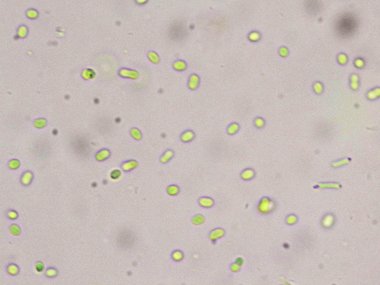
The cells are solitary, with a regular elongated-oval, elliptical, or rod-like shape and strictly rounded ends, exhibiting a rich emerald-green color. The cell wall is smooth and thin, lacking spines or long needles; the cells are surrounded by a minimal, visually faint layer of exopolysaccharide slime. Reproduction occurs exclusively by binary transverse cell division in a single plane. According to Dussart’s size classification of plankton, based on the average metric characteristics of the cells (length: 1.5–3.5 μm, width: 1.0–2.0 μm), the strain belongs to nanoplankton (a group of medium-sized microorganisms ranging from 2 to 20 μm), bordering on the picoplankton fraction.
Cultivation
- culture medium: BG-11 medium
- temperature: 24–28 °C
- light intensity: 60–120 µmol photons/m²/s
- photoperiod: 16 h light / 8 h darkness
- pH of the medium: 7.5–8.2
Physiological Characteristics
Halotolerant.
Long-term Preservation Conditions
maintained for long-term storage on BG-11 medium (liquid or solidified with 1.5% agar) at 12–15 °C under low light intensity (5–10 μmol photons m⁻² s⁻¹) with a 12 h light/12 h dark photoperiod. Storage on culture shelves with subculturing every three months is considered optimal. Storage in a refrigerator at 4–8 °C is also acceptable, provided that the cultures are not kept in complete darkness.
Genetic Information
GenBank accession №PZ747266
Field of Application
in fundamental research and biotechnology.