


Nostoc calcicola K-1
Cyanophyta › Cyanophyceae › Nostocales › Nostocaceae › Nostoc
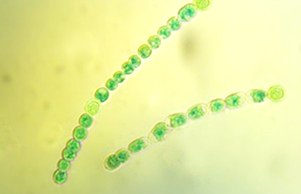
Description
History of Receipt and Isolation
- Country of origin: Republic of Kazakhstan
- Place of isolation: Almaty Region.
- Habitat: soil.
- Isolator(s): Zayadan B.K., Sadvakasova A.K. in the Biotechnology Laboratory of Al-Farabi Kazakh National University.
- Year of accession to the collection: 2014.
- Method of strain obtainment: Isolated from an enrichment culture obtained from a natural sample by sequential microbiological streaking.
- Genetic features: Wild type (WT)
- Strain condition: axenic
Morphology and Structure
dense, interwoven trichomes of cyanobacteria forming colonies of rounded or elongated shape. Trichome diameter is 2.5–5.0 µm, they are blue-green in color and enclosed in narrow colorless sheaths. Heterocysts (differentiated cells) are rounded, about 4–6 µm in diameter. Colony sizes range from 20 to 200 µm.
Cultivation
- Nutrient Medium: Gromov No. 6 medium (liquid and agarized)
- Temperature: 26–28 °C
- Light Intensity: 50–150 µmol photons/m²/s
- Photoperiod: 16:8 h (light/dark)
- pH: 6.5–7.0
Physiological Characteristics
mesophile, autotroph, nitrogen-fixing.
Long-term Preservation Conditions
maintained on liquid and 1.5–2.0% agarized Gromov No. 6 medium. Storage temperature 10–12 °C, light intensity 10–20 µmol photons/m²/s, photoperiod 12:12 h (light/dark). Subculturing is carried out as needed, but at least once every 2–4 months.
Deposition Information
deposited in 2015 into the Republican Collection of Microorganisms of the Republic of Kazakhstan. Registration Number: A-RKM 0678
Field of Application
in fundamental research and biotechnology. Productivity note: the dry biomass content reaches 2.0–2.5 g/L. Its composition includes: proteins – 25–30%, carbohydrates – 48–56%.