


Cyanobacterium sp. IPPAS B-1200
Cyanobacteriota › Cyanophyceae › Chroococcales › Geminocystaceae › Cyanobacterium
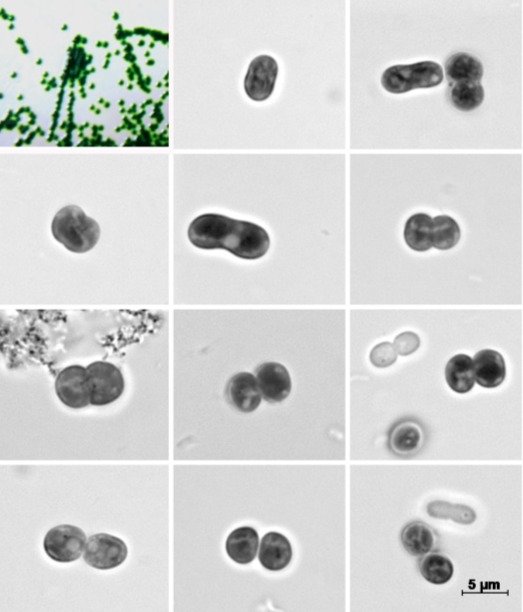
Description
History of Receipt and Isolation
- Country of origin: Republic of Kazakhstan
- Place of isolation: Lake Balkhash
- Habitat: brackish water ecosystem
- Isolator(s): Sarsekeyeva F.K., Zayadan B.K.
- Year of accession to the collection: 2014
- Method of obtainment: Isolated from an enrichment culture obtained from a natural sample by sequential microbiological streaking
- Genetic features: wild type
- Strain condition: axenic
Morphology and Structure
Cells are non-motile, solitary or in pairs after division, without gelatinous envelopes, oval to rod-shaped with rounded ends, straight or slightly arcuate; average cell length is 4.5–7.5 µm and width 2.0–4.5 µm. The cell content is not differentiated into centroplasm and chromatoplasm. Cell division is by binary fission in the plane perpendicular to the long cell axis, producing two identical daughter cells. Thylakoids are radial in cross-sections and oriented lengthwise in longitudinal sections; inclusions comprise carboxysomes and bodies of low electron density; an S-layer and sheaths are absent. The strain excretes a considerable amount of mucilage that is not attached to the cells. Colonies on agar medium are blue-green, lustrous, circular and smooth, with even margins.
Cultivation
- Nutrient Medium: Zarrouk medium (liquid and agarized)
- Temperature: 26–34 °C; grows well over a wide range of 24–34 °C
- Light Intensity: 50–150 µmol photons/m²/s
- Photoperiod: continuous illumination
- pH: 7.5–9.0
Physiological Characteristics
alkaliphile, mesophile, light-loving, autotroph.
Long-term Preservation Conditions
Stored on liquid and 1.5–2.0 % agarized Zarrouk mineral medium. Storage temperature 10–12 °C, light intensity 10–20 µmol photons/m²/s, light regime 12:12 h (light/dark). Subculturing is carried out as needed, but at least once every 2–4 months.
Deposition Information
maintained in another world collection under the number IPPAS B-1200 in the Collection of Microalgae and Cyanobacteria at the K.A. Timiryazev Institute of Plant Physiology of the Russian Academy of Sciences (Russia).
Genetic Information
Nucleotide sequences in GenBank: KM502966 (16S rRNA gene sequence), ASM174700v1 (draft genome).
Field of Application
In fundamental research and biotechnology for biofuel production.
Bibliography
- Starikov A.Y., Usserbaeva A., Sinetova M.A., Sarsekeyeva F.K., Zayadan B.K., Ustinova V., Kupriyanova E.V., Los D.A., Mironov K.S. (2016) Draft genome sequence of Cyanobacterium sp. strain IPPAS B-1200 with unique fatty acid composition. Genome Announc. 4(6):e01306-16. doi: 10.1128/genomeA.01306-16
- Sarsekeyeva F.K., Usserbaeva A.A., Zayadan B.K., Mironov K.S., Sidorov R.A., Kozlova A. Yu., Kupriyanova E.V., Sinetova M.A., Los D.A. (2014) Isolation and characterization of a new cyanobacterial strain with a unique fatty acid composition. Advances in Microbiology 4: 1033-1043. doi: 10.4236/aim.2014.415114
- Стариков А.Ю., Усербаева А.А., Миронов К.С., Сидоров Р.А., Заядан Б.К., Бедбенов В.С., Синетова М.А., Лось Д.А. (2018) Субстратная специфичность ацил-липидной Δ9-десатуразы жирных кислот из цианобактерии Cyanobacterium sp. IPPAS B-1200 с необычным жирнокислотным составом. Физиология растений 65(4): 270-278. doi: 10.7868/S0015330318040036.
Patents and Other Intellectual Property
- Strain Cyanobacterium sp. IPPAS B-1200 as a raw material for biofuel production (Utility Model Patent of the Republic of Kazakhstan No. 1750; Application No. 2015/0255.2 of August 11, 2015; published September 30, 2016, Bulletin No. 12). Authors: Sarsekeyeva, F. K., Zayadan, B. K., Los, D. A., Sadvakasova, A. K., Usserbaeva, A. A., & Bolatkhan, K. (2016).