


Navicula sp.
Bacillariophyta › Bacillariophyceae › Naviculales › Naviculaceae › Navicula
Description
History of Receipt and Isolation
- Country of origin: Republic of Kazakhstan.
- Place of isolation: Aktau city, industrial zone of the oil refinery, production facilities, and sampling point M-13 (at the inlet from the production units).
- Habitat: Petroleum-contaminated wastewater
- Isolator(s): B.K. Zayadan and A.A. Dauletova, K.Bolatkhan at the Biotechnology Laboratory of Al-Farabi Kazakh National University
- Year of accession to the collection: 2024.
- Method of obtainment: isolated from an enrichment culture obtained from a natural sample by sequential microbiological streaking
- Genetic features: Wild type (WT)
- Culture condition: Axenic.
Morphology and Structure
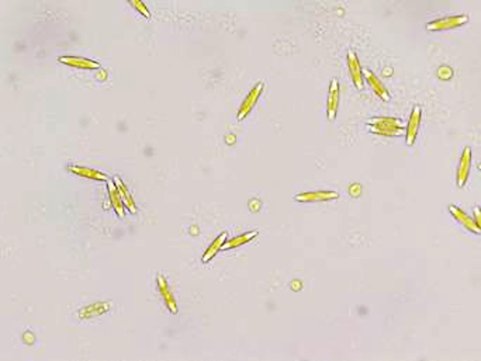
The cells are single, eukaryotic, and exhibit a golden-brown color due to the predominance of the pigment fucoxanthin. In valve view, the cells are boat-shaped or lanceolate with symmetrically rounded ends, whereas in girdle view, they are rectangular. Each cell is enclosed within a rigid, two-valved siliceous cell wall (frustule) with a distinct longitudinal raphe through which mucilage is secreted, enabling gliding motility. According to the plankton size classification (Dussart scale), the strain belongs to the nanoplankton size fraction (2–20 μm), with some stages of the life cycle gradually transitioning into the microplankton fraction (>20 μm).
Cultivation
- culture medium: F/2 medium, BG-11 medium
- temperature: 20–24 °C
- light intensity: 40–80 µmol photons/m²/s
- photoperiod: 16 h light / 8 h darkness
- pH of the medium: 7.2–7.8
Physiological Characteristics
Halotolerant.
Long-term Preservation Conditions
long-term storage on BG-11 medium (liquid or solidified with 1.2–1.5% agar) at 12–15 °C under low light intensity (5–10 μmol photons m⁻² s⁻¹) with a 12 h light/12 h dark photoperiod. Optimal preservation is achieved by storing on culture racks and subculturing every 3 months. Storage in a refrigerator at 4–8 °C is also acceptable, provided that the cultures are not kept in complete darkness.
Genetic Information
GenBank accession PZ765996
Field of Application
Utilized in fundamental research and biotechnology.