


Chlamydomonas reinhardtii CC-124
Chlorophyta › Chlorophyceae › Chlamydomonadales › Chlamydomonadaceae › Chlamydomonas
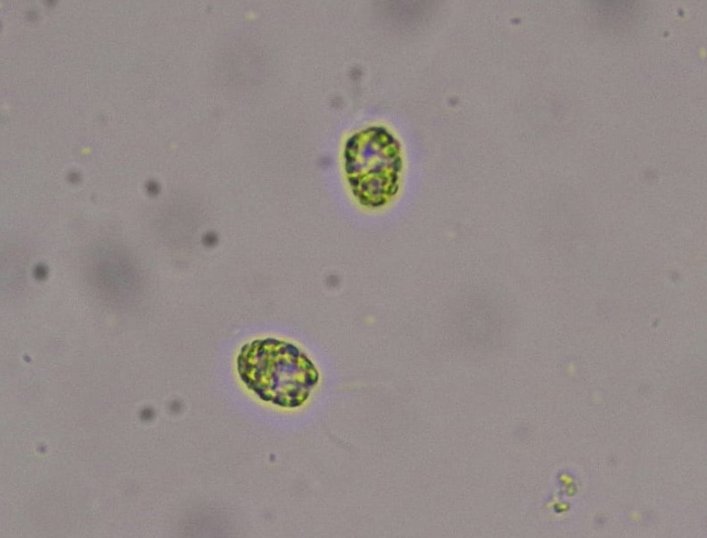
Description
History of Receipt and Isolation
- Country of origin: USA
- Place of isolation: provided by the Chlamydomonas Resource Center, Duke University
- Last identification: Zayadan B.K., Akmukhanova N.R. in the biotechnology laboratory of Al-Farabi KazNU, 2024
- Year of accession to the collection: 2001
- Method of obtainment: collection strain
- Genetic features: wild type
- Strain condition: axenic
Morphology and Structure
unicellular, round or broadly oval in shape, with an average diameter of 8–22 µm; the cell is surrounded by a cytoplasmic membrane, on the outer side of which there is a thin and clearly visible cell wall, and the cell itself is surrounded by a protective capsule in the form of a thin mucilaginous layer. The cell contains one large cup-shaped chloroplast, which is granular, has a pyrenoid region located in the central or lateral part and occupies most of the protoplast. In the motile phase, cells swim with the aid of two isomorphic anterior flagella and carry out directed phototaxis by means of an eyespot (stigma).
Cultivation
- Nutrient Medium: TAP medium (liquid and agarized)
- Temperature: 24–28 °C
- Light Intensity: 50–100 µmol photons/m²/s
- Photoperiod: 16:8 h (light/dark)
- pH: 7.0–7.5
Physiological Characteristics
mesophile, autotroph. Under optimal cultivation conditions for biomass production on days 7–8, the content of substances per 1.0–2.0 g/L of dry biomass is as follows: proteins – 38–45%, carbohydrates – 40–45%.
Long-term Preservation Conditions
maintained on liquid and 1.5–2.0% agarized TAP medium. Storage temperature 10–12 °C, light intensity 10–20 µmol photons/m²/s, photoperiod 12:12 h (light/dark). Subculturing is carried out as needed, but at least once every 2–4 months.
Deposition Information
deposited in 2003 into the Republican Collection of Microorganisms of the Republic of Kazakhstan. Registration Number: A-RKM 0130
Field of Application
in fundamental research and biotechnology.
Bibliography
- Шорабаев, Е. Ж., Саданов, А. Қ., & Заядан, Б. К. (2001). Бірклеткалы жасыл балдыр Chlamydomonas reinhardtii табиғи түрлері мен Chlorella мутант штамдарына мыс иондарының әсерін зерттеудің нәтижелері. Поиск, (1), 100–104.
- Zayadan, B. K., Sadvakasova, A. K., Saleh, M. M., & Gaballah, M. M. (2014). Generation and characterization of pigment mutants of Chlamydomonas reinhardtii CC-124. African Journal of Biotechnology, 13(2), 274–279. https://doi.org/10.5897/AJB2013.13002
- Sadvakasova, A. K., Akmukhanova, N. R., Matorin, D. N., Protopopov, F. F., Alekseev, A. A., & Zayadan, B. K. (2016). Pigment mutants of the green microalga Chlamydomonas reinhardtii: Morphological properties and photosynthetic performance. Russian Journal of Plant Physiology, 63(4), 443–450. https://doi.org/10.1134/S1021443716040130