


Fischerella sp. SZ-8
Cyanobacteriota › Cyanophyceae › Nostocales › Hapalosiphonaceae › Fischerella
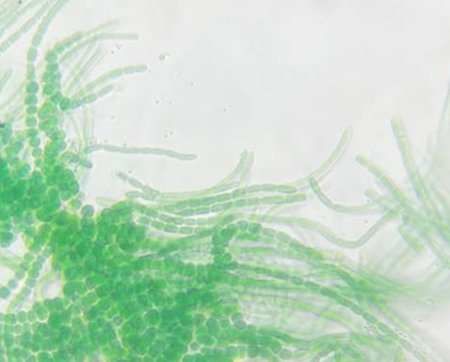
Description
History of Receipt and Isolation
- Country of origin: Republic of Kazakhstan
- Place of isolation: Zhetysu Region, Zharkent thermal spring
- Habitat: freshwater geothermal ecosystem, thermal spring
- Isolators: Akmukhanova N.R., Seiilbek S.N. at the Biotechnology Laboratory of Al-Farabi Kazakh National University
- Year of entry into the collection: 2023
- Last identification: 2024
- Method of obtainment: isolated from an enrichment culture obtained from a natural sample by sequential microbiological streaking
- Genetic features: Wild type (WT)
- Culture condition: Axenic
Morphology and Structure
filamentous. The vegetative cells are blue-green and cylindrical, short-cylindrical, or barrel-shaped and are arranged in uniseriate trichomes. The filaments exhibit true branching. Both intercalary and terminal heterocysts occur.
Cultivation
- culture medium: liquid nitrogen-free BG-11 medium (CN = 0)
- temperature: 28 ± 2 °C
- pH of the medium: 7.5
- light intensity: 53 µmol photons/m²/s
- relative humidity: approx. 60%.
- No combined nitrogen is added to the medium, corresponding to CN = 0.
- Note: The strain is primarily maintained and cultivated in liquid nutrient medium. Growth on solid agar medium is weak.
Physiological Characteristics
mesophile.
Long-term Preservation Conditions
maintained in liquid nitrogen-free BG-11 medium at room temperature and transferred to fresh medium every 2–3 months. Lyophilized biomass is stored at +4 °C in airtight containers protected from moisture, light, and oxygen. The recommended storage period for the lyophilized biomass is 1–3 years.
Genetic Information
The partial nucleotide sequence of the 16S rRNA gene of Fischerella sp. SZ-8 has been registered in the international GenBank database under accession number PZ692527.
Field of Application
The strain is intended for use in fundamental scientific research and biotechnology.