


← Back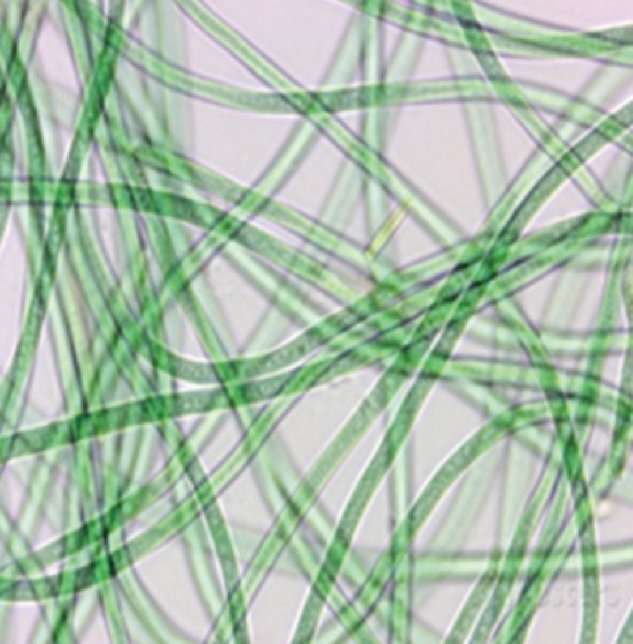
QCCPM-CY-028
Phormidium foveolarum WW-2
Cyanobacteriota › Cyanophyceae › Oscillatoriales › Phormidiaceae › Phormidium
Description
History of Receipt and Isolation
- Country of origin: Republic of Kazakhstan
- Place of isolation: sewage treatment facilities of Almaty city
- Habitat: wastewater
- Isolator(s): Zayadan B.K., Akmukhanova N.R. in the biotechnology laboratory of Al-Farabi KazNU
- Year of accession to the collection: 2010
- Method of obtainment: Isolated from an enrichment culture obtained from a natural sample by sequential microbiological streaking.
- Genetic features: Wild type
- Culture condition: axenic
Morphology and Structure
Trichomes are blue-green, single, straight, 2.3–2.8 µm wide, constricted at the transverse septa, and curved towards the ends. Granulation is absent. Cells are 1.5–1.7 µm long, terminal cells are flatly rounded, without a calyptra.
Cultivation
- Nutrient Medium: Gromov No. 6 medium (liquid and agarized)
- Temperature: 26–28 °C
- Light Intensity: 50–150 µmol photons/m²/s
- Photoperiod: 16:8 h (light/dark)
- pH: 6.5–7.0
Physiological Characteristics
mesophile, autotroph, α-mesosaprobe.
Long-term Preservation Conditions
maintained on liquid and 1.5–2.0% agarized Gromov No. 6 medium. Storage temperature 10–12 °C, light intensity 10–20 µmol photons/m²/s, photoperiod 12:12 h (light/dark). Subculturing is carried out as needed, but at least once every 2–4 months.
Field of Application
in fundamental research and biotechnology.