


Scenedesmus quadricauda B-1
Chlorophyta › Chlorococcophyceae › Protococcales › Scenedesmaceae › Scenedesmus
Description
History of Receipt and Isolation
- Country of origin: Uzbekistan
- Place of isolation: provided by the Collection of the Institute of Botany, Academy of Sciences of Uzbekistan
- Last identification: Zayadan B.K., Akmukhanova N.R., Sadvakasova A.K. in the biotechnology laboratory of Al-Farabi KazNU, 2016
- Year of accession to the collection: 2016
- Method of obtainment: collection strain
- Genetic features: Wild type
- Strain condition: axenic
Morphology and Structure
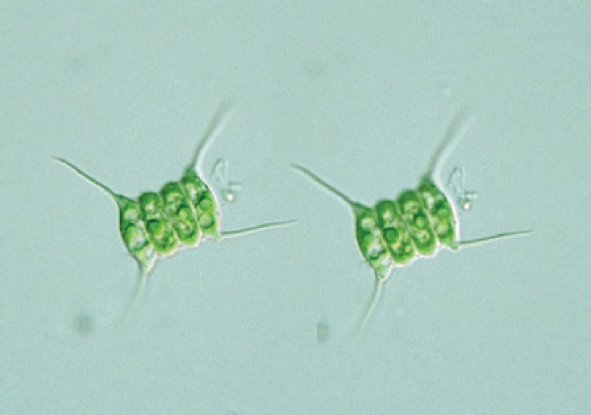
Coenobia are uniseriate, 2–4–8, rarely 16-celled. Cells are oval-cylindrical or elongated-oval; marginal cells have one or two concave straight spines at the ends. The wall is smooth. The chromatophore is peripheral with one pyrenoid and a nucleus. Cells are 7–15 µm, more often 12–20 µm.
Cultivation
- Culture medium: Gromov medium No. 6
- Temperature: 26–28 °C
- Light intensity: 40–70 µmol photons/m²/s
- Light regime: 16:8 h (light/dark)
- pH: 6.5
Physiological Characteristics
Photoautotroph, mesophile, neutrophile, oligohalobe, and producer of valuable secondary metabolites and antioxidants.
Long-term Preservation Conditions
The culture is maintained on liquid and 1.5–2.0% agar-solidified Tamiya mineral medium. The storage temperature is 10–12 °C, light intensity is 10–20 µmol photons/m²/s, with a 12:12 h light/dark photoperiod. The culture is subcultured as required, but at least once every 2–4 months.
Deposition Information
Certificate of microorganism deposition No. 09/12-306, 2016. The strain was deposited in the Republican State Enterprise on the Right of Economic Management “Republican Collection of Microorganisms” of the Science Committee of the Ministry of Education and Science of the Republic of Kazakhstan. Registration number – A-RKM 709.
Field of Application
It is used in biotesting as a test object for toxicity assessment, followed by applications in bioremediation, bioenergy, and pharmacology.