


Ankistrodesmus sp. B11
Chlorophyta › Chlorophyceae › Sphaeropleales › Ankistrodesmaceae › Ankistrodesmus
Description
History of Receipt and Isolation
- Country of origin: Republic of Kazakhstan
- Place of isolation: Lake Balkhash
- Habitat: lake
- Isolator(s): Zayadan B.K., Akmukhanova N.R., Sadvakasova A.K., Bauenova M.O. in the biotechnology laboratory of Al-Farabi KazNU
- Year of accession to the collection: 2016
- Method of obtainment: isolated from an enrichment culture obtained from a natural sample by sequential microbiological streaking
- Genetic features: Wild type
- Strain condition: Axenic
Morphology and Structure
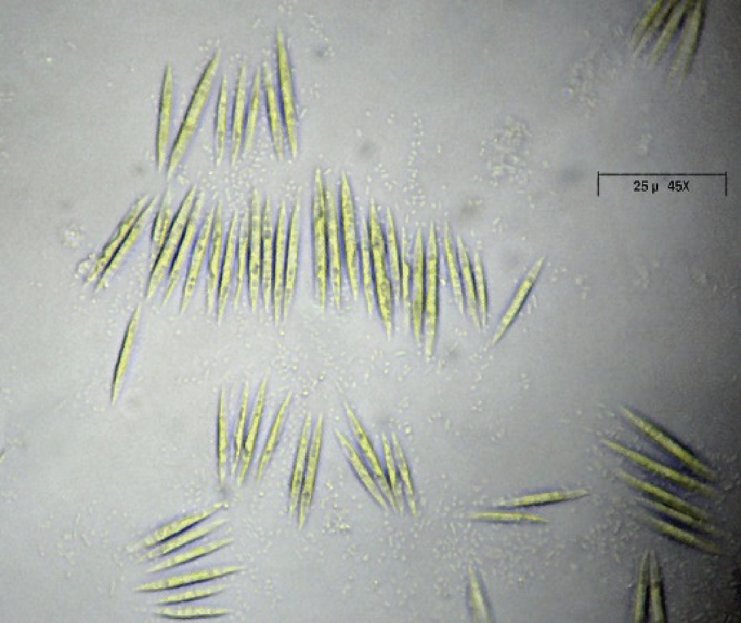
unicellular; they mainly form fan-shaped or fasciculate clusters, united mostly in the central part. Cells are elongated, straight or slightly curved, gradually narrowed and pointed towards the ends (needle-shaped). The wall is smooth, thin, colorless. Reproduction occurs through 2–4–8–(16) autospores, which are arranged parallel to each other within the mother cell and released when the mother cell ruptures. It grows well on liquid and solid Tamiya medium at a temperature of 25–30 °C. When growing on liquid nutrient medium, they do not settle to the bottom and do not overgrow the vessel walls. On solid nutrient medium, they form round, smooth, and convex colonies with even edges. Colony diameter is 2–3.5 mm, colored green.
Cultivation
- Culture medium: medium Tamiya
- Temperature: 25–30 °C
- Light intensity: 40–70 µmol photons/m²/s
- Light regime: 16:8 h (light/dark)
- pH: 6.5
Physiological Characteristics
Photoautotroph, mesophile, neutrophile. Under optimal cultivation conditions for biomass production (on Tamiya medium at t 26–28 °C, pH 6.5 and continuous CO₂ supply) on days 7–8, the content of substances per 1.5–2.0 g/L of dry biomass is: proteins — 48–50 %, carbohydrates — 40–45 %.
Long-term Preservation Conditions
Preservation is carried out on agarized BG-11 medium at a temperature of 12–14 °C and low light intensity of 4–6 µmol photons/m²/s. The maximum storage period without subculturing is 2–3 months.
Deposition Information
Certificate of microorganism deposition No. 09/12-307, 2016. The strain was deposited in the Republican State Enterprise on the Right of Economic Management “Republican Collection of Microorganisms” of the Science Committee of the Ministry of Education and Science of the Republic of Kazakhstan. Registration number – A-RKM 710.
Field of Application
In biotesting as a test object for toxicity assessment, followed by bioremediation, bioenergy, and pharmacology.