


Chlamydomonas reinhardtii CC-137
Chlorophyta › Chlorophyceae › Chlamydomonadales › Chlamydomonadaceae › Chlamydomonas
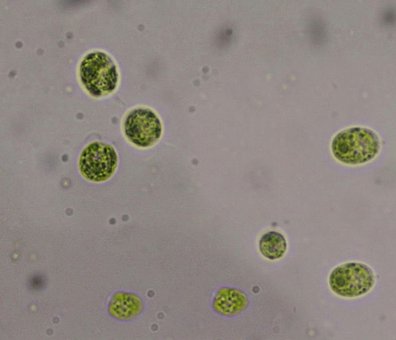
Description
History of Receipt and Isolation
- Country of origin: Russia
- Place of isolation: provided by the algal culture collection of the microbiology laboratory of the Research Institute of Biology, St. Petersburg State University, St. Petersburg (CALU)
- Year of accession to the collection: 2001
- Last identification: Zayadan B.K., in the biotechnology laboratory of Al-Farabi KazNU, 2024
- Method of obtainment: collection strain
- Genetic features: wild type
- Strain condition: axenic
Morphology and Structure
unicellular; motile; a globose, broadly oval, or slightly ovoid morphotype. The cell is enclosed by a cytoplasmic membrane adjacent to a well-defined external cell wall, peripherally surrounded by a protective capsule in the form of a thin mucilaginous layer. The cell contains a single large, cup-shaped chloroplast with a granulate stroma and a visible pyrenoid zone in the basal part. Cells swim by means of two anterior isomorphic flagella and demonstrate directional phototaxis through an eyespot (stigma).
Cultivation
- Nutrient Medium: TAP medium (liquid and agarized)
- Temperature: 24–28 °C
- Light Intensity: 50–100 µmol photons/m²/s
- Photoperiod: 16:8 h (light/dark)
- pH: 7.0–7.5
Physiological Characteristics
mesophile, autotroph. Under optimal cultivation conditions for biomass production on days 7–8, the content of substances per 1.0–2.0 g/L of dry biomass is as follows: proteins – 38–45%, carbohydrates – 40–45%.
Long-term Preservation Conditions
maintained on liquid and 1.5–2.0% agarized TAP medium. Storage temperature 10–12 °C, light intensity 10–20 µmol photons/m²/s, photoperiod 12:12 h (light/dark). Subculturing is carried out as needed, but at least once every 2–4 months.
Deposition Information
deposited in 2003 into the Republican Collection of Microorganisms of the Republic of Kazakhstan. Registration Number: A-RKM 0126
Field of Application
in fundamental research and biotechnology.
Bibliography
- Чунаев, А. С., Столбова, А. В., Никулина, К., & Заядан, Б. К. (1999). Генетика биосинтеза фотосинтетических пигментов Chlamydomonas reinhardtii. Вестник Санкт-Петербургского университета. Серия 3. Биология, 4(24), 122–131.
- Заядан, Б. К. (2002). Возможности использования микроводорослей Chlamydomonas reinhardtii для генетического мониторинга в искусственной экосистеме. Вестник КазГУ. Серия биологическая, 2(17), 90–94.
- Маторин, Д. Н., Орлова, В. С., Заядан, Б. К., Алексеев, А. А., Гольцев, В. Н., & Горячев, С. Н. (2012). Изучение влияния углеродных нанотрубок на фотосинтез микроводорослей Chlamydomonas reinhardtii с использованием флуориметра М-РЕА2. Естественные и технические науки, (3), 114–116.
- Маторин, Д. Н., Тодоренко, Д. А., Ленбаум, В. В., & Заядан, Б. К. (2013). Влияние наночастиц серебра на фотосинтез зеленой водоросли Chlamydomonas reinhardtii. Вестник КазНУ. Серия биологическая, 59(3/1), 274–276.